
Can You Sell a Manhattan Apartment in Foreclosure? First Find Out Which Clock Is Running
The envelope that starts this is rarely dramatic. Sometimes it is a letter from a law firm you have never heard of, sometimes a single page taped to your door by the managing agent. Either way, the sentence people say when they call us is the same: I think I am losing the apartment, and I do not know how long I have.
That second half is the part worth fixing first. Manhattan is an unusual market among the places we buy houses across New York, because the thing most people here own is not a house and is not, legally speaking, even real estate. Manhattan is both a borough and a county — New York County — with 1,694,251 residents at the 2020 census, separated from the Bronx by the Harlem River and from Brooklyn and Queens by the East River. What sets it apart is not the water but the paperwork: most Manhattan homes are co-ops, and a co-op is shares in a corporation rather than a piece of land.
That single fact decides which law is being used against you, which courthouse you would walk into, and how many weeks you have. There are three genuinely different proceedings a Manhattan owner can be facing, and owners routinely assume they are in one when they are in another — then plan around a deadline that was never theirs.
Get Your Free Cash Offer Now!
Fill out this form to get your no-obligation all cash offer started!
Get Your Free Offer TODAY!
"*" indicates required fields
Can you still sell a Manhattan apartment once foreclosure has started?
Yes — in all three situations, right up until the auction or court-ordered sale actually happens. Nothing about a default strips your right to sell; it just puts a date on the calendar you did not choose. So the useful question is never whether you can sell, but which date you are racing — and the three proceedings below produce dates that are months apart.
Which of the three proceedings is actually against you?
Read your notice for the law it cites, not the words it uses. Almost every letter in this category says “foreclosure” somewhere, including letters about proceedings that are not foreclosures at all. The citation at the bottom — a UCC section, an index number, or a reference to your proprietary lease — tells you which of the three you are in.
What happens when the loan is secured by co-op shares?
Your lender can sell your shares at auction without ever filing a court case. Because co-op shares are personal property rather than real property, the loan is secured under Article 9 of the Uniform Commercial Code, which permits a non-judicial sale after default. There is no complaint, no index number, and no judge supervising the schedule.
The protection here is a notice period. UCC 9-611(f) requires the lender to give 90 days’ notice before disposing of a co-op interest — a provision added after the foreclosure crisis precisely because co-op owners lacked the safeguards homeowners had. Courts have vacated co-op auctions where that notice was defective, and the sale itself must be commercially reasonable under Article 9. If you are holding one of these letters, that date is your real deadline, and three months is not long to find a buyer, satisfy a managing agent, and close.
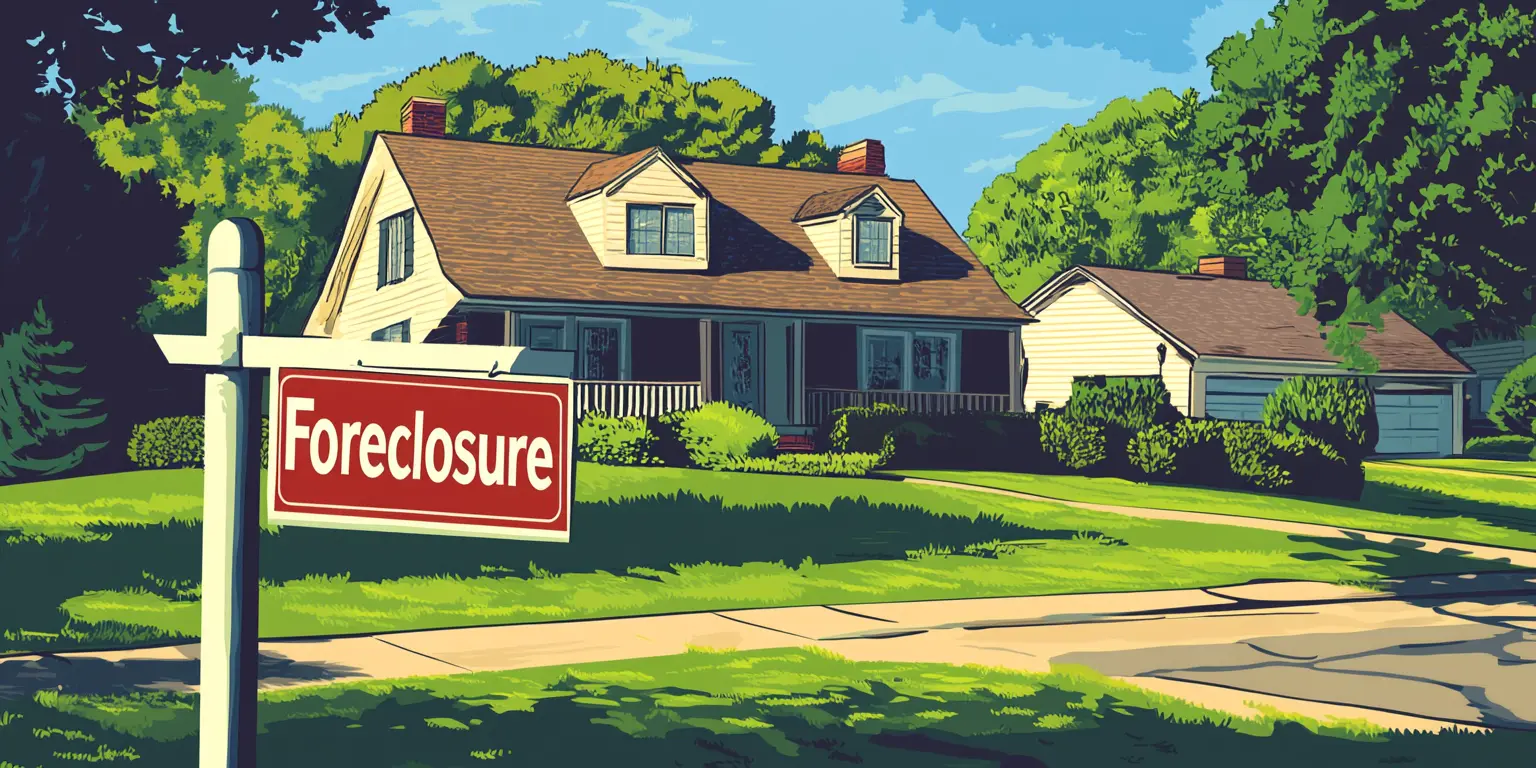
What is different if you own a condo, a brownstone, or a townhouse?
Then you own real property, and your lender has to sue you to take it. That is judicial foreclosure, filed in New York County Supreme Court at 60 Centre Street on Foley Square, and it is a far slower machine than a share auction. Under CPLR 3408, a residential foreclosure on a one-to-four family home triggers a mandatory settlement conference: a judge puts you and the lender in a room, and both sides are required to negotiate in good faith.
The honest consequence is that condo and townhouse owners usually have far more runway than they think — often well over a year from the first filing to any auction. That extra time changes the right answer.
What if it is the co-op board rather than a bank?
Then nothing is being foreclosed. Your lease is being cancelled. If you have fallen behind on maintenance, the building is not your mortgage lender and is not using mortgage law. A typical proprietary lease lets the co-op serve a notice to cure, then a notice terminating the lease, after which the corporation moves to recover possession — in Manhattan, that lands in Housing Court at 111 Centre Street, where the Help Center in Room 104 will answer procedural questions for free. Some buildings instead run the non-judicial route and go straight toward a public auction of the shares.
The trap is that a board’s clock and a bank’s clock run independently. We have spoken to owners who negotiated patiently with their lender while the building quietly terminated the lease out from under them.
So how much time does each clock really give you?
Weeks to a few months on a co-op share auction; usually a year or more on a condo or a house. That gap is the whole reason to identify your proceeding first. A co-op owner who assumes they have a year because they read a general article about New York foreclosure is making an expensive mistake; a condo owner who sells at a discount in month two, before the settlement conference, is making the opposite one. Our cash offer process runs in days, which is genuinely useful under a 90-day UCC notice and often unnecessary in a judicial case with four seasons left in it.

Will a cash sale clear all of it, or only the mortgage?
It has to clear everything attached to the home, or the closing simply does not happen. This surprises people who think of the mortgage as the only debt. On a co-op, the managing agent issues a payoff figure that can include unpaid maintenance, late fees, legal fees the building has already incurred, any open assessment, and the building’s flip tax. On a condo, unpaid common charges and any filed lien behave much the same way. All of it comes off the top.
The arithmetic behind a cash offer is simply those payoff letters added together and subtracted from the price, which is why the first thing we ask for is paperwork rather than photographs. If you sell a Manhattan apartment as-is, condition matters far less than it would on a house in the outer boroughs, because in a co-op almost nothing we might repair is ours to repair.
When is selling to a cash buyer the wrong move in Manhattan?
Whenever you have real equity and a calendar that is not genuinely short. We would rather say so now than after you have signed something. If you own a condo with meaningful equity, you are two months into a judicial case, and the settlement conference has not happened, a broker listing will almost certainly beat what any cash buyer can pay. Take the time the court is giving you.
The same goes if your arrears are small enough that the board would accept a payment plan, or if a modification is realistically on the table at the conference. A cash sale is the right tool for a hard, short deadline — a 90-day share auction notice, a lease already terminated, an estate that cannot carry maintenance. It is the wrong tool for a slow case with equity in it, and the cash buyers in Manhattan worth talking to will tell you so.
What do you need in hand before anyone can price your apartment?
Five documents, none of which require a lawyer to obtain. With these, a serious buyer can price the apartment the same week:
- The notice itself, including the page with the statute or index number on it
- Your stock certificate and proprietary lease, or your condo deed
- The current payoff letter from your lender
- The managing agent’s arrears statement, including any assessment
- The last two years of building financials, if the board will release them
If some of it is missing, say so rather than waiting for a complete set. A lost stock certificate is a solvable problem; a missed auction date is not.

We are a small, family-run New York buyer, and the first call is about dates rather than a pitch. Read us your notice and we will tell you which proceeding you are in and roughly how long it gives you, even if the answer is to let a broker sell it. If a fast as-is purchase is right, we can work to a specific closing date. Fill out the form below, or call us directly at (347) 685-9317. If you would rather read first, the details are on our we buy Manhattan apartments for cash page.
Get Your Free Cash Offer Now!
Fill out this form to get your no-obligation all cash offer started!
Get Your Free Offer TODAY!
"*" indicates required fields